
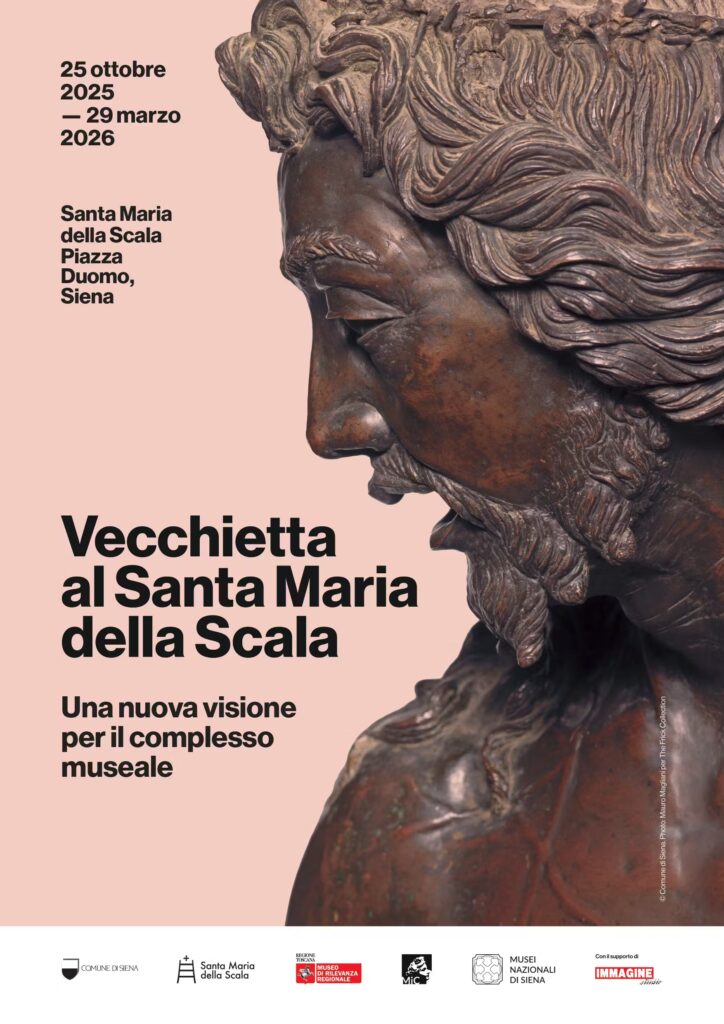
Vecchietta at Santa Maria della Scala. A new vision for the museum complex
Just over six hundred years after the birth of Lorenzo di Pietro, known as “Il Vecchietta” (born in Siena in 1410, where he died in 1480), the museum complex of Santa Maria della Scala inaugurates a new exhibition layout that, as announced, “restores centrality to the artist who more than any other has shaped its history, leaving masterpieces that still define the identity of this place.”
The exhibition, curated by Giulio Dalvit, Associate Curator at the Frick Collection in New York, “has been completely reimagined to highlight masterpieces such as the Pellegrinaio, the Old Sacristy with the Arliquiera, and the monumental Bronze Christ of the Santissima Annunziata.”
As stated in the press release, the choice was to “reorganize several of the museum’s rooms starting from the figure of the artist who worked there most profoundly.”
Il Vecchietta worked for the Hospital for over fifty years. His works — from the frescoes of the Pellegrinaio and the Old Sacristy to the bronze Ciborium, now housed in the Cathedral — go beyond mere decoration: they construct a vision and give shape to an identity.
It is from this awareness of a unique and foundational relationship that the new display of the monumental halls of the Hospital takes shape. The Old Sacristy (with the Arliquiera repositioned) regains its function as an architectural reliquary, and its frescoes are once again fully legible. The Bronze Christ of the Santissima Annunziata, one of the pinnacles of 15th-century Italian sculpture, can now, for the first time, be observed up close. The Pellegrinaio returns to the center of the visit, freed from previous exhibition structures that today appeared overly invasive.